Roasting Is Cooking, and the Clock Is the Whole Recipe
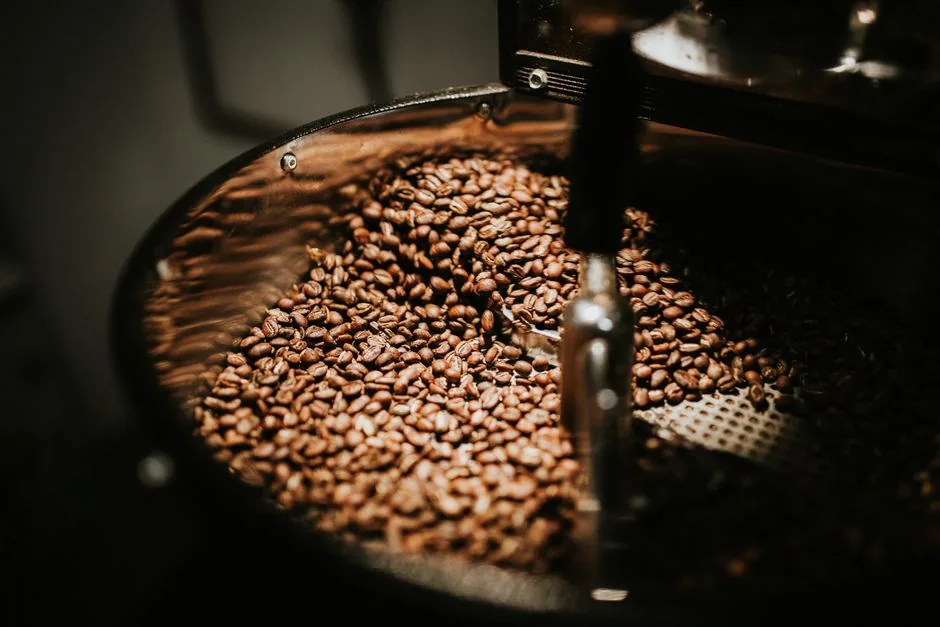
Green coffee beans are nearly flavorless. Grassy, a little vegetal, and completely uninteresting in a cup. Everything you recognize as the taste of coffee is created by heat, in a drum, over roughly ten to fifteen minutes. Where the roaster chooses to stop is the single biggest decision made about that coffee after it leaves the farm.
The useful landmarks are audible. Somewhere around 385 degrees Fahrenheit, water trapped inside the bean flashes to steam and the beans crack open with a sound like faint popcorn. Roasters call this first crack. Pull the coffee shortly after it and you have a light roast. Keep going and the sugars inside keep browning, the acids keep breaking down, and at roughly 435 degrees you reach second crack, where the cell structure fractures again and oils migrate to the surface. That sheen on a very dark bean is not sprayed on. It is the coffee's own oil, pushed out by heat.
So the difference between a light roast and a dark roast is not strength, and it is not quality. It is about four minutes of time and a few dozen degrees. What those minutes do, in one sentence: they trade the character of the bean for the character of the roast.
A light roast tastes like where the coffee came from. A dark roast tastes like what the roaster did to it. Neither answer is wrong.
What a Light Roast Actually Tastes Like
Light roasts keep more of what the green bean brought with it. The organic acids that survive a short roast read on the palate as brightness, so the vocabulary around light coffee ends up sounding like a fruit stand: citrus, berry, stone fruit, florals, sometimes a tea-like finish. An Ethiopian coffee roasted light can genuinely taste like blueberry, and that is not marketing. It is the bean, barely interfered with.
The body is lighter and cleaner, closer to tea than to cream. The color in the cup is often a shade or two paler than people expect, which trips up anyone who equates dark liquid with serious coffee. And light roasts are less forgiving. They are denser, harder, and less soluble, so they need hotter water, a finer grind, or more contact time to give up everything they have. Under-brew a light roast and it tastes thin and sour rather than bright.
Order light if you drink your coffee black and you want to taste a specific place. If you take it with a lot of milk, most of that nuance is going to be lost under the dairy.
What a Dark Roast Actually Tastes Like
Push the roast past second crack and origin character largely gives way to roast character. The acids have broken down into bitter and sweet compounds, and what is left is a cup people describe with the pantry rather than the fruit stand: dark chocolate, toasted nut, molasses, caramel, a little smoke at the far end.
Body goes up. The coffee feels heavier and rounder in the mouth, and perceived acidity drops off sharply, which is why a dark roast is often the comfortable choice for anyone who finds bright coffee sour or sharp. Dark roasts are also more brittle and more soluble, so they extract faster and more easily. That is a real advantage behind a busy counter and a real hazard at home, because the same quality means a dark roast will tip into harsh and ashy if you over-extract it.
Order dark if you want coffee that tastes unmistakably like coffee, if you drink it with milk or sugar, or if you want a cup that stands up to a cold morning on the Bay Ridge waterfront without getting lost.
The Middle, Where Most Good Coffee Actually Lives
The light-versus-dark framing is useful for understanding what heat does, but the honest answer is that a large share of the best coffee being served anywhere sits in the middle. A medium roast is developed far enough to build sweetness, caramel and body, but stopped before roast flavor paves over the bean. You get some of the fruit and some of the chocolate instead of all of one.
That is also why most espresso blends land medium or medium-dark. Espresso is a concentrated, high-pressure extraction that exaggerates whatever you feed it, and it usually gets mixed with steamed milk afterward. A roast with sweetness and body survives both of those things. A delicate light roast often does not. If you want the full tour of what happens to those shots once milk is involved, our guide to espresso drinks walks through the whole family, and the cortado versus flat white comparison covers the two that confuse people most.
The Caffeine Myth, Settled
Here is the belief worth retiring: dark roast is the strong one with all the caffeine. It is backwards, and only slightly so.
Caffeine is remarkably stable at roasting temperatures. Very little of it burns off, so two batches of the same green coffee roasted light and dark end up with nearly identical caffeine content by weight. What changes is the bean itself. Roasting drives out moisture and expands the bean, so a dark roast bean is bigger and lighter than a light roast bean. Measure your coffee with a scoop and the scoop of light roast holds more actual coffee mass, which means marginally more caffeine. Measure on a scale, which is what any cafe does at volume, and the gap is small enough to ignore.
Dark roast tastes stronger because roast flavor is assertive. Strength in the cup is mostly a function of brew ratio and method, not color. If you are genuinely tracking intake rather than flavor, we broke the numbers down by drink in how much caffeine is actually in your coffee.
Which One Should You Order?
If you drink it black
Go lighter than you think. Nothing is covering up the coffee, so the brightness and the origin character are the whole point. A light or light-medium drip is the most interesting cup on any menu for a black-coffee drinker.
If you take milk
Go medium or darker. Milk flattens delicate acidity and mutes florals, but it loves chocolate and caramel. This is the single most reliable rule of thumb in the entire conversation.
If you drink it iced
Depends which iced drink. Cold brew leans medium to dark, because slow cold extraction plus melting ice needs bolder tones to stay present. Hot-brewed coffee chilled over ice has more room for a lighter roast, and cold tends to sharpen those fruit notes rather than hide them. The cold brew versus iced coffee piece gets into why those two taste so different.
If you are buying beans for home
Match the roast to your gear. Light roasts want precision: a burr grinder, hot water, and attention. Dark roasts are more forgiving of a drip machine and a rough grind, as long as you do not let them sit on the hot plate. Medium is the safest bag to buy for a household where several people make coffee differently.
How This Plays Out at a Bay Ridge Coffee Counter
Pier 69 Market pours La Colombe coffee and Rishi tea, a block up from the water at 10 Bay Ridge Ave. The practical version of everything above is short: if you are drinking it black, say so and ask what is brightest. If you are getting a latte, you are already in the right part of the roast spectrum and you do not need to think about it. If you want to know exactly what is in the grinder on a given morning, ask at the counter. That is an easy conversation at 6 AM, which is when we open on weekdays.
It is also worth knowing that roast preference is not fixed. Plenty of lifelong dark roast drinkers find a light roast they love once somebody hands them one brewed properly, and plenty of specialty-coffee converts come back around to a deep, chocolatey cup in February. Try the other side of the spectrum occasionally. Worst case, you learn something about your own palate for the price of a cup.
If you are ordering for a crowd rather than yourself, coffee for a group is better sorted out by phone than guessed at online. Call (718) 777-6969 and we will work out quantities and timing with you, or see the catering page for how we usually handle it.
Taste the Difference for Yourself
La Colombe coffee and Rishi tea at 10 Bay Ridge Ave, one block up from the Bay Ridge waterfront. Open 6 AM weekdays, 7 AM weekends, until 9 PM. Delivery through GetSauce.