A Neighborhood Built Facing the Water
Walk Bay Ridge long enough and you start noticing names that do not match anything else in Brooklyn. A park called Leif Ericson. A square named for a Norse explorer who died a thousand years ago. Streets of churches whose cornerstones carry Scandinavian lettering. None of it is decoration. For roughly seventy years, this stretch of southwest Brooklyn held the largest concentration of Norwegians anywhere in the United States, and at its height the community here was counted in the tens of thousands.
The reason is the same reason the neighborhood exists in the shape it does: the harbor. Bay Ridge sits on the eastern shore of the Narrows, the mile-wide gate that every ship entering New York has to pass through. In the late nineteenth century, that gate was one of the busiest working waterfronts on earth, and the piers, dry docks, shipyards and chandleries that serviced it needed a very particular kind of labor.
Norway sent sailors. Brooklyn needed sailors. The rest was arithmetic.
Why Norwegians, and Why Here
Norway in the 1800s was a country of fjords and small farms with a merchant fleet far out of proportion to its population. When agricultural pressure and limited land pushed people out, enormous numbers left, and a disproportionate share of them were men who already knew how to work a ship. Many went to the Midwest for farmland. The ones who stayed in the maritime trades had to live where the ships were.
Southwest Brooklyn put a man within walking distance of the docks, which was no small thing in a pre-automobile city. Seamen came ashore between voyages, took rooms in boarding houses run by other Norwegians, and found that the shipyards would hire them permanently. Shipbuilding, rigging, carpentry, marine engineering, tugboat crews, harbor pilots: this was a skilled-trade community, and it settled into Bay Ridge and the southern end of Sunset Park intending to stay.
Community then compounds the way it always does. A church gets built so services can be held in Norwegian. A seamen's mission opens to look after sailors between ships. A benevolent society, a lodge, a nursing home, a bakery that knows how to make the right bread. Each one gives the next arriving family a reason to pick this neighborhood over any other, and within a generation the choice stops being a choice at all.
Lapskaus Boulevard
The commercial spine of Norwegian Brooklyn was Eighth Avenue, running north from Bay Ridge through Sunset Park, and it had a nickname that tells you everything about it. Locals called it Lapskaus Boulevard, after the beef-and-potato stew that is about as Norwegian as food gets.
What earned the name was density. Bakeries selling cardamom bread and kringle. Butchers with fish pudding and cured meats. Delicatessens stocking brown cheese and flatbread. Travel agencies whose entire business was booking passage home and back again. If you spoke only Norwegian, you could run a week of errands on that avenue and never need a word of English, which is precisely why so many people never bothered to learn much of it.
That avenue is now the center of one of Brooklyn's largest Chinese communities, and the bakeries sell different bread. That is not a loss so much as a continuation. Eighth Avenue has been an immigrant main street for well over a century; it has simply changed which immigrants. Our guide to moving to Bay Ridge gets into how layered the area still is.
The Landmarks That Stayed
Leif Ericson Park and Square
If Norwegian Brooklyn has a civic center, it is here, in the blocks around Eighth Avenue and Fort Hamilton Parkway in the 66th and 67th Street range. Leif Ericson was the Norse explorer credited with reaching North America around the year 1000, roughly five centuries ahead of Columbus, and for Norwegian immigrants that was not trivia. It was a claim: we were here first, and we belong here now. A monument to him was dedicated in the park in 1939, during the period when Norway's royal family was visiting New York, and the park and the adjoining square still carry the name.
Churches and institutions
The Lutheran churches of Bay Ridge are the most durable physical record of the community. Several were founded specifically to hold services in Norwegian, and while almost all of them now worship in English and serve congregations with no connection to Norway, the buildings and their cornerstones remain. The same is true of the Norwegian nursing and care institutions established in the neighborhood, some of which still operate under their founding names. These are not museums. They are working buildings that happen to be evidence.
The 17th of May
Norwegian Constitution Day falls on the seventeenth of May, and Bay Ridge still marks it with a parade, organized by Norwegian American community groups rather than by the city. It is the one day a year when the heritage becomes loud again: flags, bunad, marching bands, a crowd along the avenue. Routes and dates shift from year to year, so if you want to see it, confirm the details with the organizing committee rather than assuming last year's plan still applies.
What Happened to Little Norway
Two forces broke it, and neither was dramatic. The first was the collapse of the working waterfront. Containerization in the 1950s and 1960s moved cargo handling to New Jersey and made thousands of Brooklyn dock and shipyard jobs disappear. The entire economic reason to live within walking distance of the piers evaporated.
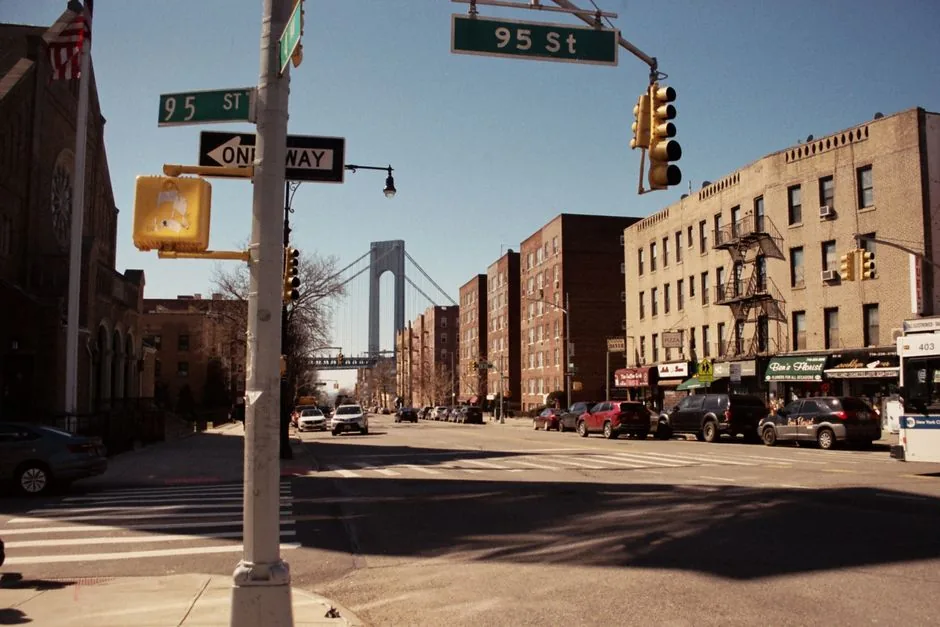
The second was the car. The Verrazzano-Narrows Bridge opened in 1964 and put Staten Island and then New Jersey within commuting range. Families who had done well did what successful immigrant families generally do: they bought houses with lawns somewhere quieter. The children assimilated, married out, moved out. By the 1980s what had been a neighborhood was a diaspora with a parade.
Bay Ridge, meanwhile, did not empty out. It filled with Italian, Irish, Greek, Lebanese, Palestinian, Syrian, Chinese and Russian-speaking families, which is why the neighborhood today is one of the genuinely mixed parts of the city. The Norwegian layer is just the one underneath.
Walking the Norwegian Map
You can see most of it on foot in an afternoon, and it works better as a harbor walk than a history tour. Start at the water, because the water is the whole explanation.
- The 69th Street Pier. Stand at the end of it and look at the Narrows. Every ship that mattered to this community came through that gap.
- Shore Road and the promenade. The waterfront walk traces the shoreline the shipyards worked. Narrows Botanical Gardens sits along it.
- Up the ridge. Climb east and uphill toward Fourth, Fifth and Eighth Avenues. The grade you are walking is the ridge the neighborhood is named for, explained in why it is called Bay Ridge.
- Leif Ericson Park. Finish at the monument and the square. It is a working neighborhood park with ballfields, not a shrine, which is somehow the right note.
Where We Fit In
Pier 69 Market is at 10 Bay Ridge Avenue, one block up from the water, which puts us at the bottom of that walk rather than at the end of it. We are a waterfront cafe first, and a good share of what we make goes out the door with people heading toward the pier, the promenade or Owls Head Park. If you are doing the Norwegian loop, start here, not after.
We pour La Colombe coffee and Rishi tea. We open at 6 AM Monday through Friday and 7 AM on weekends, and we stay open until 9 PM, which covers both the early walk and the late one. Delivery runs through GetSauce. If you are bringing a group through the neighborhood, or putting food together for a club or a commemoration, the catering page explains how we usually handle it and a call to (718) 777-6969 is faster than a form.
The reason this history is still legible is that Bay Ridge has never been a neighborhood that tears itself down. The churches stayed churches, the park kept its name, the row houses kept their stoops. The place has a memory, which is a good quality in a neighborhood and a better one in a coffee shop.
Start the Walk With a Coffee
La Colombe coffee and Rishi tea at 10 Bay Ridge Ave, one block up from the Bay Ridge waterfront. Open 6 AM weekdays, 7 AM weekends, until 9 PM. Delivery through GetSauce.