The Film That Made Bay Ridge Shorthand for Brooklyn
Most neighborhoods never get a movie. Bay Ridge got one that became a cultural event, and nearly fifty years later people still come down here looking for it. Saturday Night Fever was released at the end of 1977, made John Travolta a star, sold one of the best-selling soundtrack albums in history, and fixed a particular image of working-class Brooklyn in the public imagination for a generation.
What is easy to forget is how local it all was. The story began as a 1976 New York magazine article by Nik Cohn about the Saturday ritual of a Brooklyn disco crowd. The production then came out to southwest Brooklyn and shot it on location: real streets, a real nightclub, a real pizza counter, real row-house blocks with stoops and aluminum awnings. The neighborhood was not a set dressed to look like Brooklyn. It was Brooklyn, working, with a camera crew in the way.
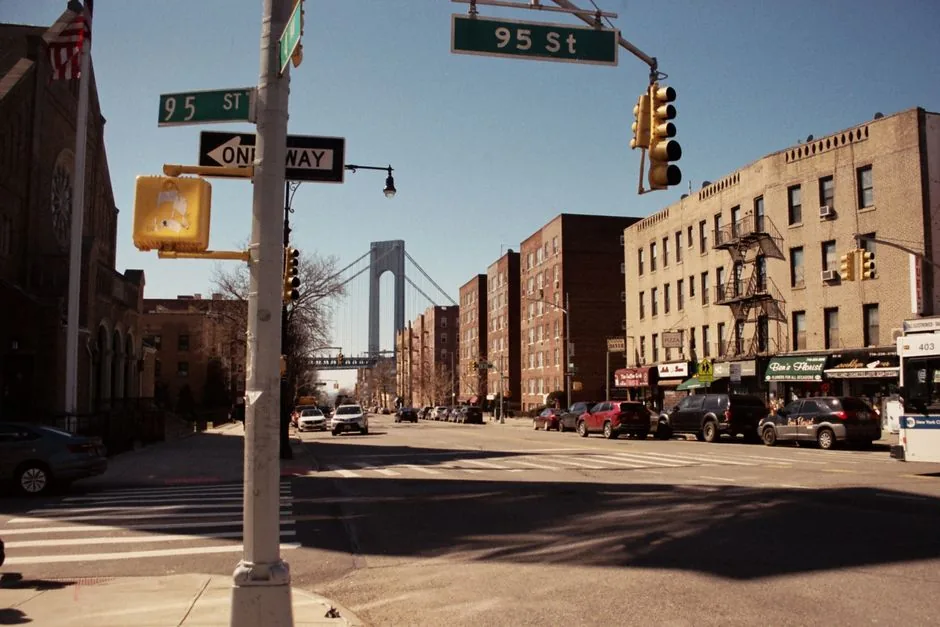
The bridge in the background of that movie is the same bridge in the background of our morning rush. That part has not changed at all.
86th Street and the Opening Walk
The sequence everybody remembers is the first one: Tony Manero swinging a paint can down a commercial street, past storefronts, with the elevated train overhead. That is 86th Street, and the elevated structure is the BMT West End line, the route the D train still runs today.
The pizzeria from that scene, the one where he stacks two slices and eats them walking, stood at 1969 86th Street. It closed after roughly seventy years in business, which means the single most photographed storefront in Bay Ridge movie history is no longer a pizzeria. That is worth knowing before you go, because the disappointment is avoidable if you expect it.
The street, though, is intact in the way that matters. It is still a dense, loud, awning-covered shopping strip under the tracks, still full of people running errands on foot, still the part of Bay Ridge where commerce happens at street level. If you want to understand why that opening sequence works, walk four blocks of 86th Street on a Saturday afternoon. Our Bay Ridge shopping day guide covers the same stretch from a practical angle.
802 64th Street: Where 2001 Odyssey Stood
The dance floor, the one lit from underneath, was in a club called 2001 Odyssey at 802 64th Street. It was a working neighborhood disco before the film arrived and a tourist curiosity afterward, and it spent the following decades changing hands and changing names. It finally closed in the 2010s, and the building was later demolished.
So there is nothing to see, exactly. No plaque, no facade, no velvet rope. What you get is the ordinary experience of standing on a mixed residential and commercial block in the sixties streets, a short walk from the Fifth and Eighth Avenue corridors, realizing that the most famous dance floor of the 1970s was in a low building on a street like any other. For a lot of people that is the whole point of a location walk.
The Verrazzano-Narrows Bridge
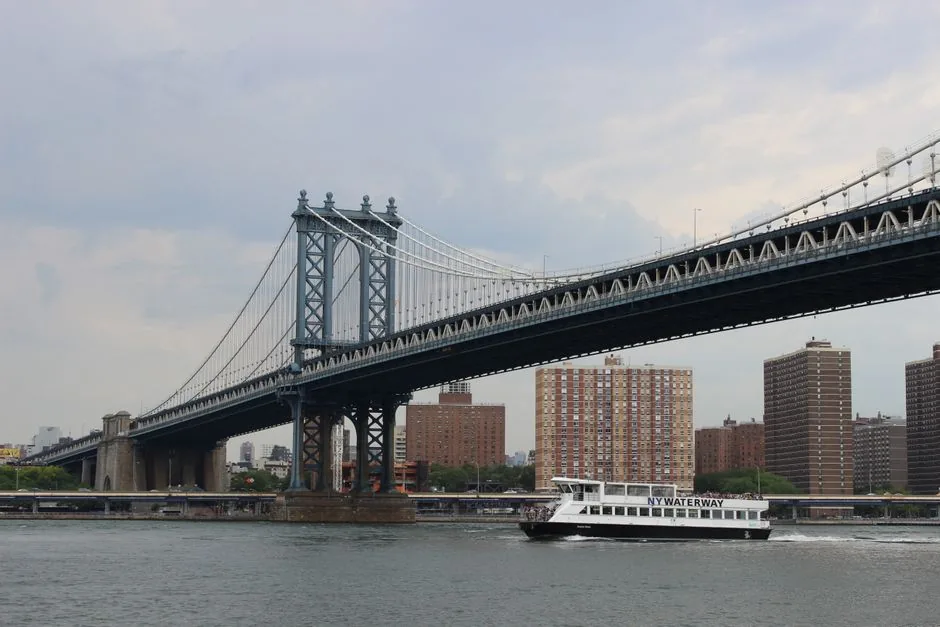
The bridge is the real co-star. It hangs over the back half of the film, it is where the characters go to act out, and it functions as the thing Tony can see but cannot cross, the exit from a life measured in blocks. If the movie has a landscape, this is it.
Two notes for anyone coming to look at it. First, the spelling changed: the official name was corrected to Verrazzano-Narrows, with two z's, in 2018, after decades of the misspelling. Second, you cannot walk it. There is no everyday pedestrian or bicycle access, and the only times people cross on foot or by bike are organized events like the start of the New York City Marathon and the annual Five Boro Bike Tour.
Where to actually see it
- The 69th Street Pier. Walk to the end and the bridge fills the sky to your left. This is the single best free view in the neighborhood.
- The Shore Road promenade. The waterfront walk runs for miles with the bridge ahead of you the entire way south.
- Owls Head Park. Climb the hill for the harbor-and-bridge angle from above. Our guide to the park and the cafe below it has the approach.
- Golden hour. The towers catch the light late in the day. See photo spots in Bay Ridge for the specifics.
If you want the bridge itself rather than the movie, we wrote a full guide to the Verrazzano-Narrows Bridge from the Bay Ridge side, including how it reshaped the neighborhood when it opened in 1964.
The Rest of the Map, and a Word About Respect
Beyond those anchors, the film's Bay Ridge is mostly interiors, storefronts and private homes, and that is where location hunting gets delicate. The row house long identified by location guides as the Manero family home sits on 79th Street, a quiet residential block of the kind Bay Ridge has hundreds of. It is somebody's house. People live there now who had nothing to do with a movie made before many of them were born.
Look from the sidewalk, briefly, quietly, and move on. Do not ring the bell, do not set up a tripod on the stoop, do not stage a dance sequence in front of it. The reason Bay Ridge still looks like the film is that it has stayed a real neighborhood of people who live here, rather than a set preserved for visitors, and that is a condition worth protecting.
Walking the Route
The locations are not in a neat line, so the walk works best as a loop that ends at the water.
- Start on 86th Street under the elevated tracks, around the old pizzeria block, and walk it as a street rather than a photo stop.
- Cut to 64th Street and the 802 address. Allow five minutes and no expectations.
- Head downhill west toward the harbor. You are crossing the ridge the neighborhood is named for, which is covered in why it is called Bay Ridge.
- Finish at the waterfront for the bridge: the pier, the promenade, or the park above it.
Getting here is straightforward. The R train runs under Fourth Avenue with stops at Bay Ridge Avenue, 77th Street and 86th Street, which puts the whole route within a few blocks of transit. If you are driving, our notes on parking and transit near the waterfront will save you a lap of the block. And if the 1977 of it all has you curious about what was here before, the Norwegian history of Bay Ridge is the layer underneath the one the movie filmed.
Where We Come In
Pier 69 Market sits at 10 Bay Ridge Avenue, one block up from the water, which is roughly where this walk runs out of film locations and turns into a view. We are a waterfront cafe, and a fair share of what we hand across the counter goes out the door with people heading for the pier or the promenade.
We pour La Colombe coffee and Rishi tea. We open at 6 AM Monday through Friday and 7 AM on weekends and stay open until 9 PM, so an early start or a sunset finish both work. Delivery runs through GetSauce if you would rather not interrupt the walk, and the menu is online. If you are bringing a group through the neighborhood, the catering page explains how we handle it, and calling (718) 777-6969 is faster than filling out a form.
Nearly fifty years on, what is striking is not how much of the movie is gone. It is how much of the neighborhood is still here: the same hills, the same stoops, the same elevated train, the same bridge closing off the horizon at the end of every westbound street. The disco closed. The coffee shop is still open.
End the Walk at the Water
La Colombe coffee and Rishi tea at 10 Bay Ridge Ave, one block up from the Bay Ridge waterfront. Open 6 AM weekdays, 7 AM weekends, until 9 PM. Delivery through GetSauce.